Physical Infrastructure Buildout, week ending 27 July 2026
Stratum Atlas · Weekly · 27 July 2026 · Edition 3 evidence cut on Kimi K3
On 16 July we said Kimi K3 was a recipe print, not a physical clearance print, and that the call could change after weights and the technical report. Those landed. Moonshot released the open weights, the report, and the training stack around it. The 2.5× scaling efficiency versus Kimi K2 is no longer a launch claim waiting on a PDF. It is in the report, with fitted scaling curves.
This week’s question is narrower than the leaderboard. Does a better open frontier recipe mean the AI physical buildout is overspent? Where does demand slow? Where does it keep rising? Who still captures? Sold out is not the same as uncancelable. Demand quality — real customer funded, creditworthy leverage, or circular financing — is how we separate those two. We use it at the end to score the book and each name we name. First, the call and the physical split.
The call
Kimi K3 proves a better approach to converting training compute into capability. It does not prove the campus, power, and package co minima are cleared.
What slows from here is naive training intensity, closed model pricing power, and circular financing that needs a scarcity narrative to fund itself. What keeps rising is serving memory residency, test time tokens, HBM and package attach for hosts that actually run this class of model, and the power and campus path behind those hosts.
Edition 2’s provisional call still holds on clearance. Edition 3 upgrades the efficiency watchlist from provisional to confirmed, and splits the demand book by quality, not just by headline size.
What Moonshot actually printed
Kimi K3 is a 2.8 trillion parameter Mixture of Experts model with about 104 billion activated parameters, native vision, and a 1 million token context window. Versus K2, total parameters rose about 167 percent and activated parameters rose about 220 percent. Experts active per token rose from 8 of 384 to 16 of 896. Context rose 8×.
The efficiency claim is structural. Kimi Delta Attention, Attention Residuals, Stable LatentMoE, and refined training recipes deliver about 2.5× overall scaling efficiency versus K2 on Moonshot’s fitted curves. Absolute pretraining token count, total training FLOPs, and cluster SKU mix remain thinner than we wanted for a full K2 proxy recompute. Relative conversion improved. Absolute job size is still not a clean primary print.
On memory, the split that matters:
Versus FP16 of the same size, MXFP4 expert weights with MXFP8 activations cut weight memory and serving cost. Roughly 1.4 TB of weights instead of something near 5.6 TB in sixteen bit.
Versus K2, K3 is heavier to host, not lighter. All experts still have to reside. Sparsity cuts FLOPs per token. It does not cut residency. Long context and always on reasoning raise the KV and token bill after the weights are loaded.
Open weights widen who can host. They do not make frontier hosting small. Day zero serving still wants multi node, high bandwidth domains. Moonshot’s own guidance stays on supernode configurations with 64 or more accelerators. Prefix cache and Mooncake style routing cut token cost on hits. They do not retire the cluster.
Better recipe. Still a memory bound serving object.
Where demand slows
1. Naive training intensity
If CapEx was underwritten as if every next frontier step required a linear or worse jump in pretraining FLOPs forever, that assumption is now weaker. K3 shows you can get more intelligence per unit of training compute than the prior open stack. Future incremental training cluster orders can soften without the physical valves clearing.
That is intensity relief, not clearance. CoWoS weeks, HBM contracts, LPT leads, and interconnect clocks do not shorten because a scaling curve improved. The first dollars to slip are the ones that were only justified by endless training intensity, not the prepaid slots already sitting against named offtake.
2. Closed model rents and soft API assumptions
Open weights plus aggressive cache hit pricing pressure proprietary token monopolies. The overspend here is in underwriting that assumed closed frontier APIs stay expensive forever. Price compression hits software margins first. It then hits the offtake and GPU lease structures that were underwritten off those rents. Real inference demand does not disappear because an API price falls. Funding that needed the API rent to clear does.
3. Fragile offtake and weak buyer cash
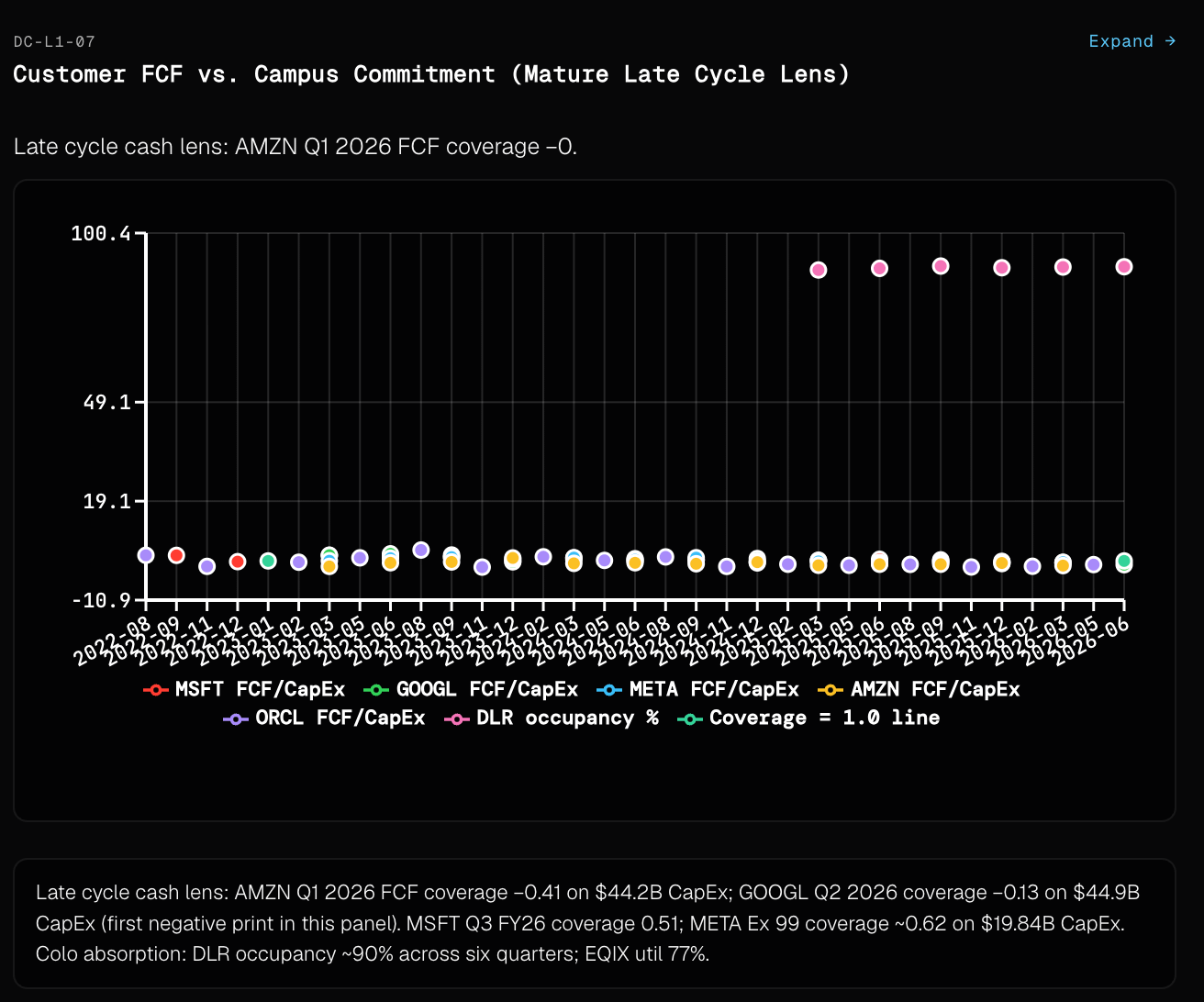
Sold out books can still cancel. On the Data Center desk, CapEx confirms the cycle and free cash coverage is the late cycle tell. Spend can be real CapEx and still sit in circular financing territory when coverage prints negative.
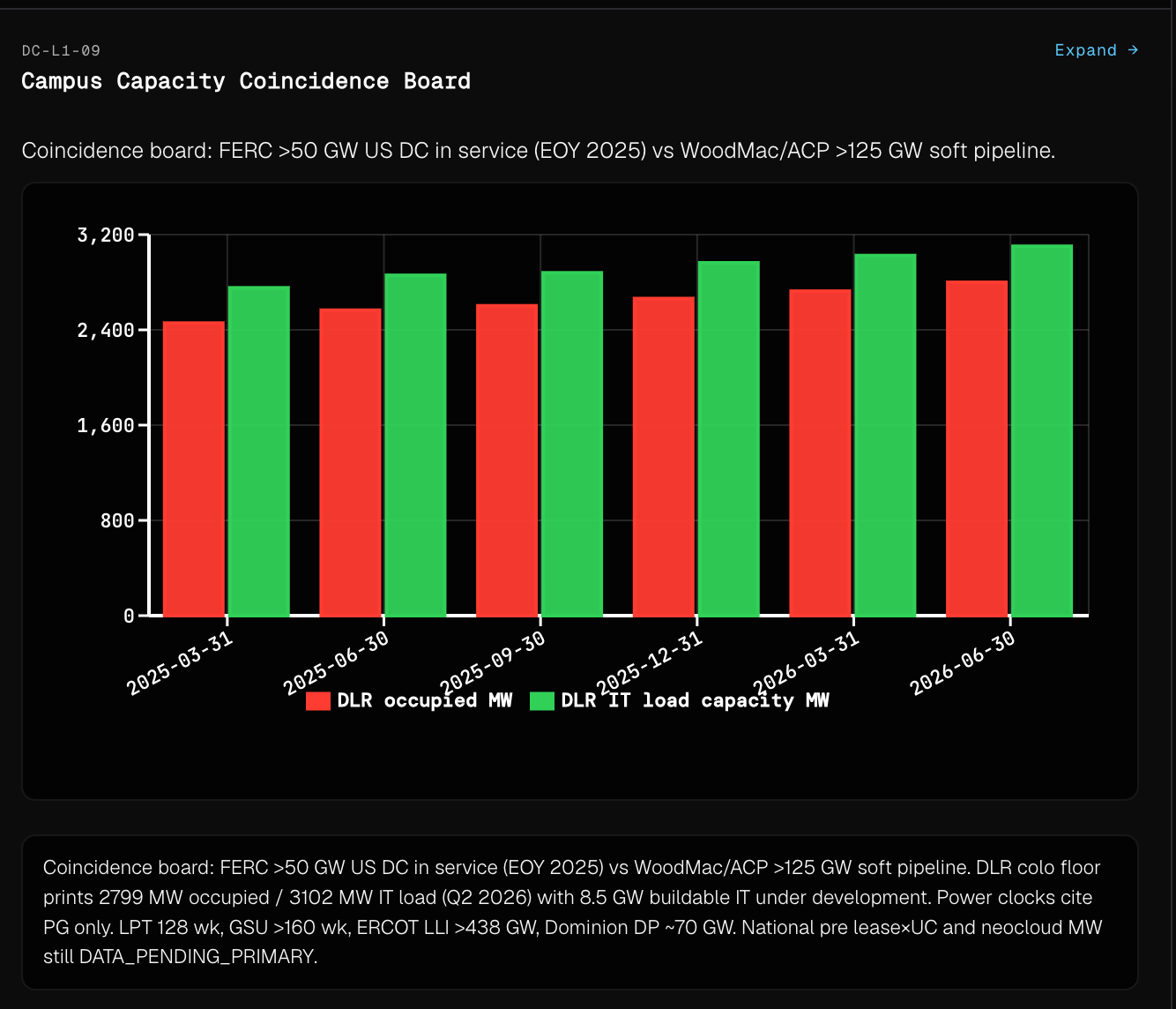
Latest panel: AMZN Q1 2026 CapEx $44.2B with FCF −$18.2B (coverage about −0.41). GOOGL Q2 2026 CapEx $44.9B with FCF −$5.9B (coverage about −0.13, first negative print in this panel). MSFT and META still cover, but coverage is compressed — MSFT about 0.51, META about 0.62 on $19.84B CapEx. Intention still runs ahead of energized and IT filled throughput. Soft national pipeline still sits far above the in service floor — FERC above 50 GW US DC in service versus soft pipeline prints above 125 GW. That is where overspend lives today: announced spend and announced megawatts with weak demand quality, not “AI no longer needs hosts.”
Where demand keeps rising
1. Serving memory and accelerator residency
K3 class models still force large resident memory domains. MXFP4 made 2.8T hostable. It did not make it casual. More open hosts means more parties trying to keep multi terabyte weight sets warm, not fewer GPUs in aggregate. A funded colo or hyperscaler host is not the same as a circular GPU lease book — but the residency bill itself does not go away.
2. Test time tokens
Always on reasoning, agents, tools, and million token context push inference burn. Training can get more efficient while inference spend rises. That is the second axis Moonshot itself frames in the report. Token economics improve on cache hits. Total tokens asked for can still climb.
3. HBM, packaging, and IT fill attach
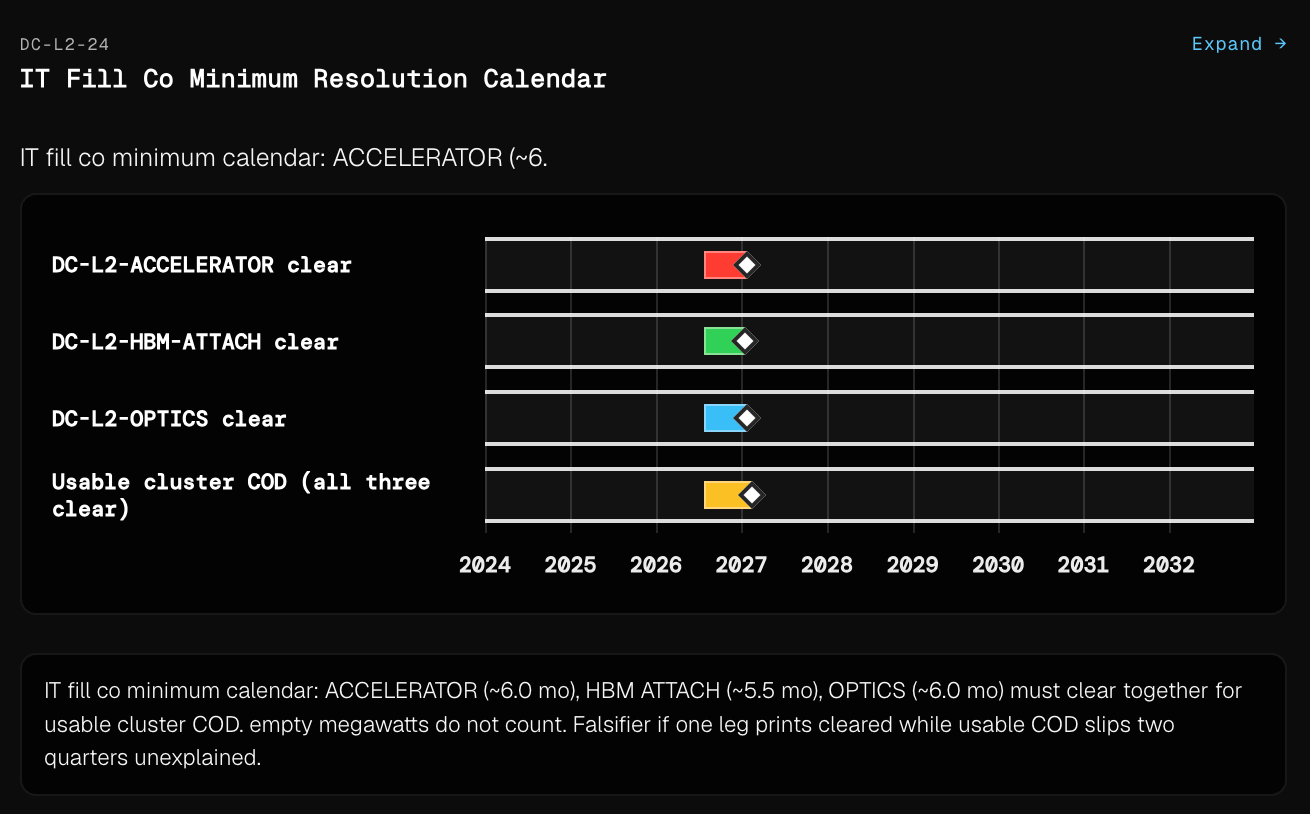
Because experts must reside, memory capacity and bandwidth stay binding for anyone serious about hosting. Empty campus megawatts still fail if accelerator, HBM attach, and optics do not clear together. On the campus desk, IT fill remains inside the co minimum. On the prior semiconductor cut, CoWoS, ABF, T glass, HBM, and allocator priority were the package valves. K3 does not open those books by itself.
4. Power and campus for real hosts
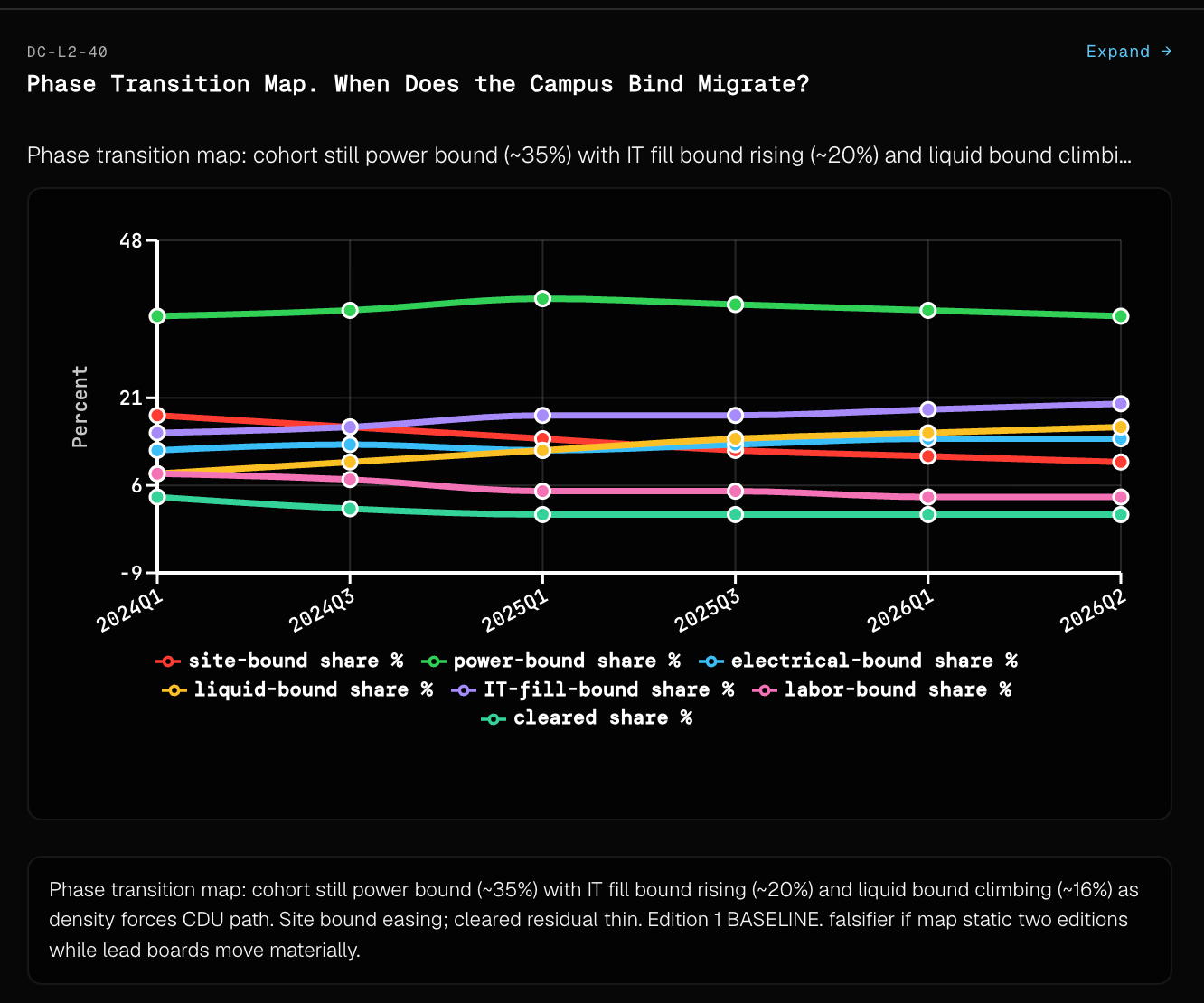
Anyone who actually serves this class of model still needs power attach, site clearance, UPS and liquid path, and shell that can take density. The Data Center edition still stalls as a campus co minimum: power delivery cited from Power and Grid, site and water gates, UPS and CDU long poles, EPC and MEP, and IT fill. Phase mix remains power bound first, with IT fill bound and liquid bound rising as rack density climbs.
The rising leg is not every announced campus. It is hosts that convert: absorbed colo, creditworthy offtake, and power paths already contracted into conversion. Soft pipeline without cash is not rising demand. It is intention.
Who captures — and what demand quality says about each name
Money does not sit with every name that touches AI. It sits with the valves that remain scarce after the recipe improves. Durability follows demand quality: margin tied to real customer funded or creditworthy leverage keeps more persistence; margin tied to circular financing gets cut hardest if open weights compress rents.
Vertiv
Measured long pole on UPS and CDU. Backlog ran $6.3B → $15.0B, with a 12–18 month ship window and mid cards near ~65 weeks UPS / ~52 weeks CDU. Book to bill about 2.9×. Capture 5 on the campus gatekeeper board. FY2025 sales about $10.23B, with services $1.84B (18 percent) — product scarcity still outgrew services.
Demand quality: mostly creditworthy leverage — hyperscaler and colo CapEx, prepaid and backlog that can still pay if the narrative slips. Persistence takes a creditworthy haircut on the board (−1). The circular risk is not Vertiv’s own books so much as the buyer mix behind them: if AMZN and GOOGL style coverage stays negative and offtake softens, ship windows can compress from the customer side. Vertiv prepaid product line split is still pending as a campus CR numerator print — that is why campus CR stays provisional, not because the UPS lead disappeared.
Equinix
Capture 5 on absorbed colo and interconnection. Cabinet utilization about 77 percent. Disclosed MRR growth about +12 percent YoY on the edition cut. Live throughput and recurring rent, not soft pipeline GW.
Demand quality: closer to real customer funded and creditworthy leverage than almost anyone else on the campus desk. Tenants paying recurring rent for occupied cabinets are sticky in a way announced megawatts are not. Watch the disclosed JV and related party structures (xScale, atNorth) as creditworthy leverage with a circular edge if related party funding thickens — not as the same thing as undeveloped national pipeline.
Digital Realty
Capture 4. The firm colo floor on this edition: IT load 3,102 MW, occupied 2,799 MW at 90.2 percent occupancy, with 8.5 GW buildable IT under development (Q2 2026). Occupancy has held near 90 percent across six quarters.
Demand quality: creditworthy leverage to real customer funded on the occupied and leased floor. The 8.5 GW buildable book is a different animal — closer to intention until it converts. NoVA capacity JV language sits in the named structures register as disclosed leverage, not as circular by default. Read DLR as two books: absorbed MW (durable) and buildable pipeline (score case by case).
NVIDIA
Capture 5 on campus IT fill. Designer and allocator rent still prints — gross margin near ~75 percent on the campus cut. Flagship campus accelerator wait still prints on the order of ~6 months. Empty MW is not usable COD without this attach.
Demand quality: creditworthy leverage on priority hyperscaler and funded colo books. The circular edge is the neocloud and vendor financed channel that only clears if GPU rents stay high — and any equity or prepaid loops that need the scarcity story to keep funding itself. Open weights pressure that fragile channel first. They do not retire residency for hosts that actually run K3 class models.
Broadcom and Arista
Both Capture 5 on the networking and AI fabric path. Density and cluster size still pull switching and Ethernet AI attach when serving domains stay multi node and high bandwidth.
Demand quality: mostly creditworthy leverage — CapEx from IG hyperscalers and funded campuses that need the fabric to clear. Less exposed to soft API rents than closed model software; more exposed if circular neocloud builds that were ordering fabric on rising GPU lease assumptions defer. Durable as long as funded hosts keep rising. Fragile where the only customer was circular GPU finance.
Coherent and Lumentum
Capture 4 on optics. Stay in the path when density and cluster size rise and the fabric needs light, not just silicon.
Demand quality: creditworthy leverage on accelerator and campus attach that clears with funded IT fill. Same cancel hierarchy as Broadcom and Arista: priority funded books first, circular residual last. Segment mix still carries measured caveats on the board — isolatable margin, not the same persistence haircut story as Vertiv’s UPS lead.
Eaton
Capture 4 on electrical. Sits beside Vertiv on the inside fence power train — not the UPS/CDU long pole, but part of the electrical scarcity that still prints when campuses actually energize.
Demand quality: creditworthy leverage from hyperscaler and colo electrical CapEx. Same buyer cash risk as Vertiv: durable while offtake is IG or take or pay; haircut if the circular share of campus dollars rises and undeveloped pipeline is what was pulling orders.
Who sits lower — and why that matters for K3
Super Micro and CoreWeave sit in the lower Capture band on this desk for a reason. Integrator revenue and neocloud scale can print without owning a durable physical valve. Edition language tags the neocloud path Circular-Fragile until four quarters of positive free cash with investment grade offtake prove otherwise. If open weights compress GPU rents, this is where cancel and deferral show up first — not at a 128 week transformer or a sole source GOES mill.
Power delivery
The campus desk cites Power and Grid rather than rebuilding it. IA without COD still prints about 549 GW. Large power transformers near 128 weeks. GSUs above 160 weeks. Heavy duty gas slots and interconnection without COD still gate energization. Recipe efficiency does not mint a second US GOES mill or cut those leads.
Demand quality: utility rate base and contracted ESA demand sit higher — closer to creditworthy leverage and, where ratepayers clear it, real customer funded — than undeveloped queue intention. Soft queue GW without conversion is the circular looking residual on the power side of the same story.
Demand quality — how we score the book
Atlas does not treat every announced gigawatt or every CapEx guide as the same kind of demand.
Demand quality asks whether the cash behind announced capacity is:
Real customer funded — end buyer or taxpayer cash that does not need the scarcity story to keep going
Creditworthy leverage — prepaid slots, project debt, or policy credit with a creditworthy root that can still pay if the narrative slips
Circular financing — vendor to vendor, captive, round tripped, or otherwise only real if the same buildout keeps funding itself
Demand quality score (circularity ratio, or CR) is the share of the cycle that only stays real if the buildout keeps funding itself:
circular or self reinforcing demand dollars ÷ total cycle demand under study
Low score means mostly real customer funded. Mid score means creditworthy leverage dominates. High score means circular financing dominates. Missing evidence never gets called real customer funded.
On this campus edition, CR sits near 0.55 and stays provisional until prepaid splits print cleaner (Vertiv product line split still pending). Demand class mix on the midpoint band is roughly real customer funded ~3 percent, creditworthy leverage ~41 percent, and circular financing ~56 percent of a ~$294B annualized midpoint campus dollar band.
Why it matters for K3: open weights and cheaper tokens hit circular financing first. They do not automatically cancel creditworthy prepaid slots or real colo absorption. They do not clear a transformer lead.
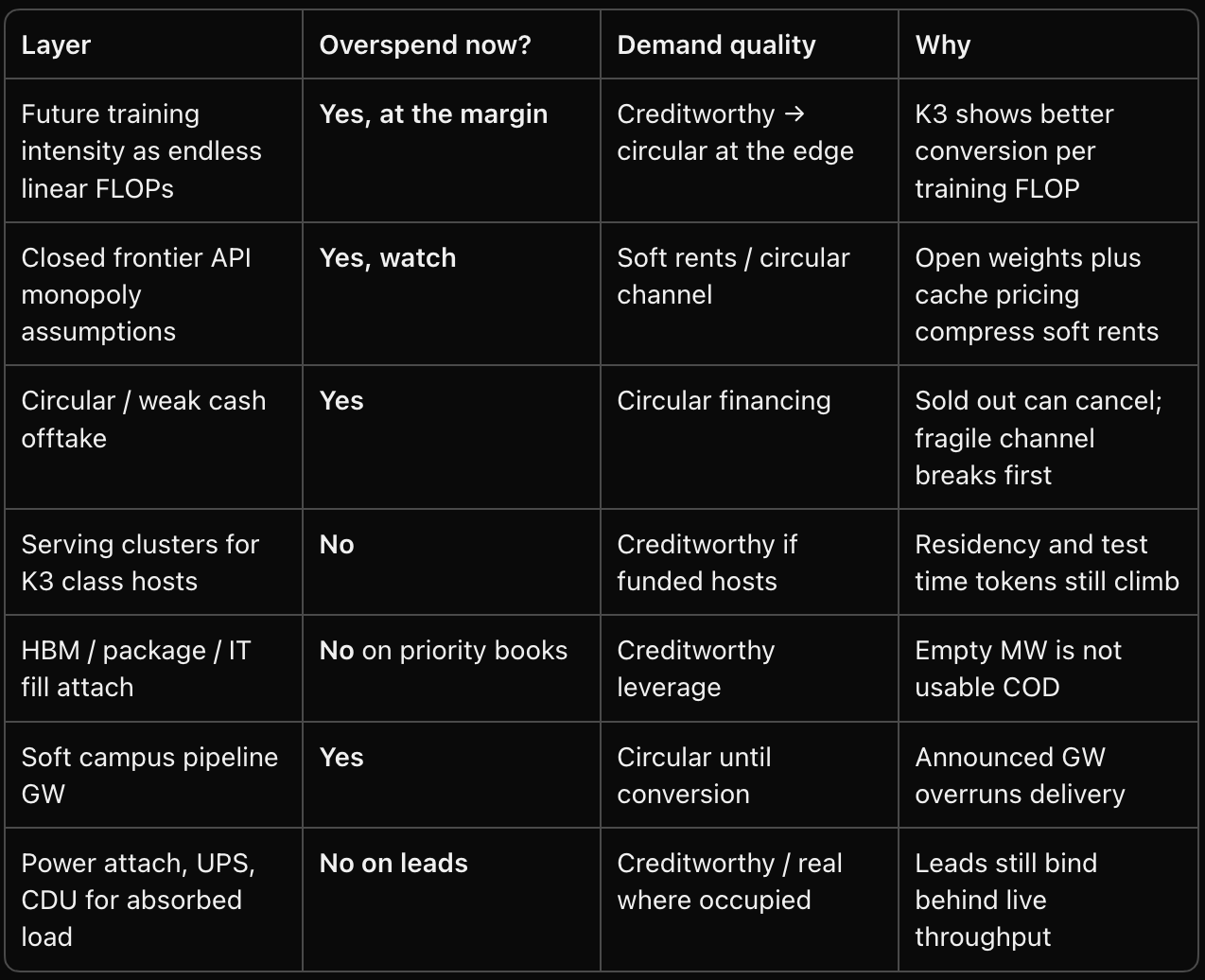
Kimi proves you can train smarter. It does not prove hosts no longer need memory, power, and accelerators. The overspend is in weak demand quality — intention and circular financing — not in every physical valve.
What would change the call
Keep these dated.
Efficiency stays confirmed, clearance stays closed unless absolute K3 training compute prints cleanly and a package or facility co minimum releases in the same window
Training intensity softens if hyperscaler and lab CapEx guides cut for compute clusters while serving and campus conversion stay firm
Circular financing breaks if two consecutive Big 4 quarters cut guides and colo development pipelines shrink without a power side explanation, or if campus CR rises further while free cash coverage stays negative
Demand quality improves if organic and creditworthy shares rise on the campus mix and prepaid splits move CR out of provisional
Serving demand keeps rising unless open weight hosting fails to proliferate and token volumes flatten on named platforms
Campus co minimum holds through 2027 unless UPS and CDU leads ease cleanly, IT fill attach opens, and Power and Grid IA to COD relief prints together
Package co minimum softens only on primary prints: CoWoS allocation opening, unsold 2027 HBM, or allocator priority books breaking — not on a blog
Bottom line
Edition 2 asked whether K3 was clearance. Edition 3 answers: it is a better approach, not a clearance event.
Demand slows where buyers were paying for endless training intensity, closed model rents, and circular financing. Demand keeps rising where open frontier models still have to live in memory, burn tokens at test time, attach HBM and packages, and pull power through a campus — and where the cash behind that ask is real customer funded or creditworthy leverage.
Sold out can cancel. Demand quality tells you which sold out book is sticky. Watch conversion and cash coverage first. Watch lead times second. Do not confuse a scaling law win with a transformer that shipped.
Open the desk
This letter is judgment on top of versioned editions. How to Use Stratum covers reading the Atlas Terminal and Atlas AI, including demand quality and the circularity score. Request access for the living desks across Power and Grid and Data Centers.
How to Use: https://www.thestratumatlas.com/research/how-to-use
Terminal evidence: Stratum Atlas Data Centers edition 27 July 2026; Power and Grid edition 19 July 2026; prior semiconductor package cut 18 July 2026 cited for IT fill context. Primary model sources: Moonshot AI, Kimi K3 technical report and open weights, July 2026; Kimi K3 blog; Kimi Team, “Kimi K2: Open Agentic Intelligence,” arXiv:2507.20534.