Physical Infrastructure Buildout, week ending 12 July 2026
This is the first edition of the Stratum Atlas weekly. Each week we cut across the full physical buildout — semiconductors, power, data centers, defense, nuclear, robotics, quantum, and fusion — and tell you where delivery stalls, who captures the margin, and what would change the call. The intelligence behind each verdict is live on the Atlas Terminal.
The physical buildout is not one story. It is a set of co minima that either clear together or stop delivery. This week’s edition across The Stratum Terminal still says the same thing in semiconductors: demand is real, manufacturing is self funded, and the chain is sold out deep enough that rent prints at the valves. The interesting question is not whether AI chips are growing. It is which stages can still stop a finished package from shipping, who converts that scarcity into margin, and where the bind migrates if packaging eases.
We lead there. Then we cut across critical materials, because the magnet and processing stack is the quiet link between chips adjacent supply chains, humanoids, and defense. The rest of the book follows as short briefs. Power and Grid stays off the lead on purpose. The live IC Summary for that desk is open on Atlas Memo.
The binding story: semiconductors
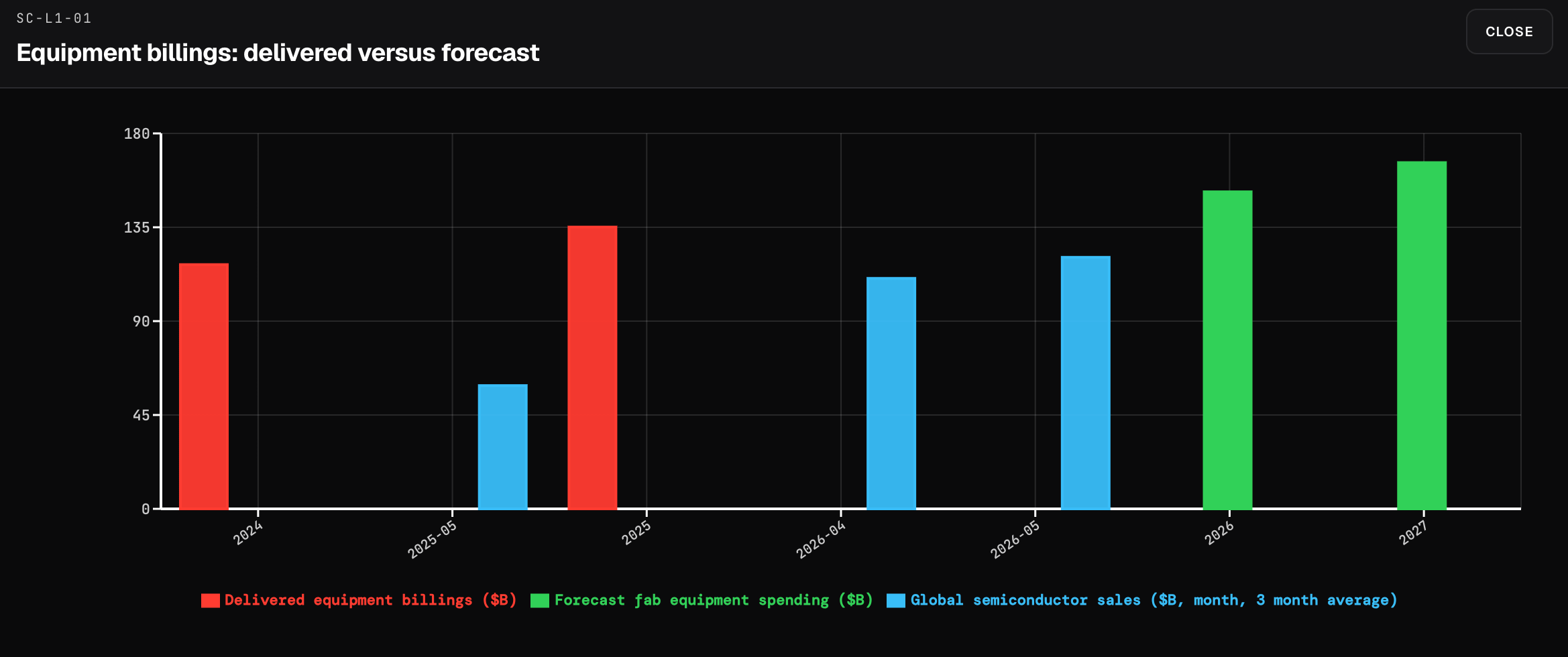
Monthly global semiconductor sales hit a record $120.6 billion in May 2026, up 104 percent year over year. Equipment billings ran a record $36.6 billion in Q1 2026 after $135.1 billion in 2025. TSMC printed June revenue of NT$442.68 billion, up 67.9 percent year over year, and delivered NT$1,270.4 billion across Q2 at the high end of guide while spending toward the high end of a $52 billion to $56 billion capex band. That is not intention. That is delivered throughput against a sold out book.
Eleven of fifteen evaluated stages on our stall board pass. The co minimum every AI accelerator must still clear together is narrower and harder:
CoWoS packaging at TSMC: sold out through 2026, 52 to 78 week leads, capacity path from about 75,000 toward 125,000 to 130,000 wafers per month by year end
ABF film at Ajinomoto: over 95 percent share, shortage since H1 2026, about a 30 percent price increase absorbed, no new plant until 2032
T glass cloth at Nittobo: near 90 percent share, gap above 40 percent in 2H 2026, nothing before mid 2027
HBM wafer starts and stacking backend: 2026 sold out at SK hynix, Samsung, and Micron; 2027 contracts taken from Q1; trade estimates still put installed TC bonders under 100
NVIDIA package allocation: about 50 to 60 percent of 2026 CoWoS reserved on the priority book
Who gets paid
Money sits with the valves that own those chokepoints, plus the designer that rations finished packages.
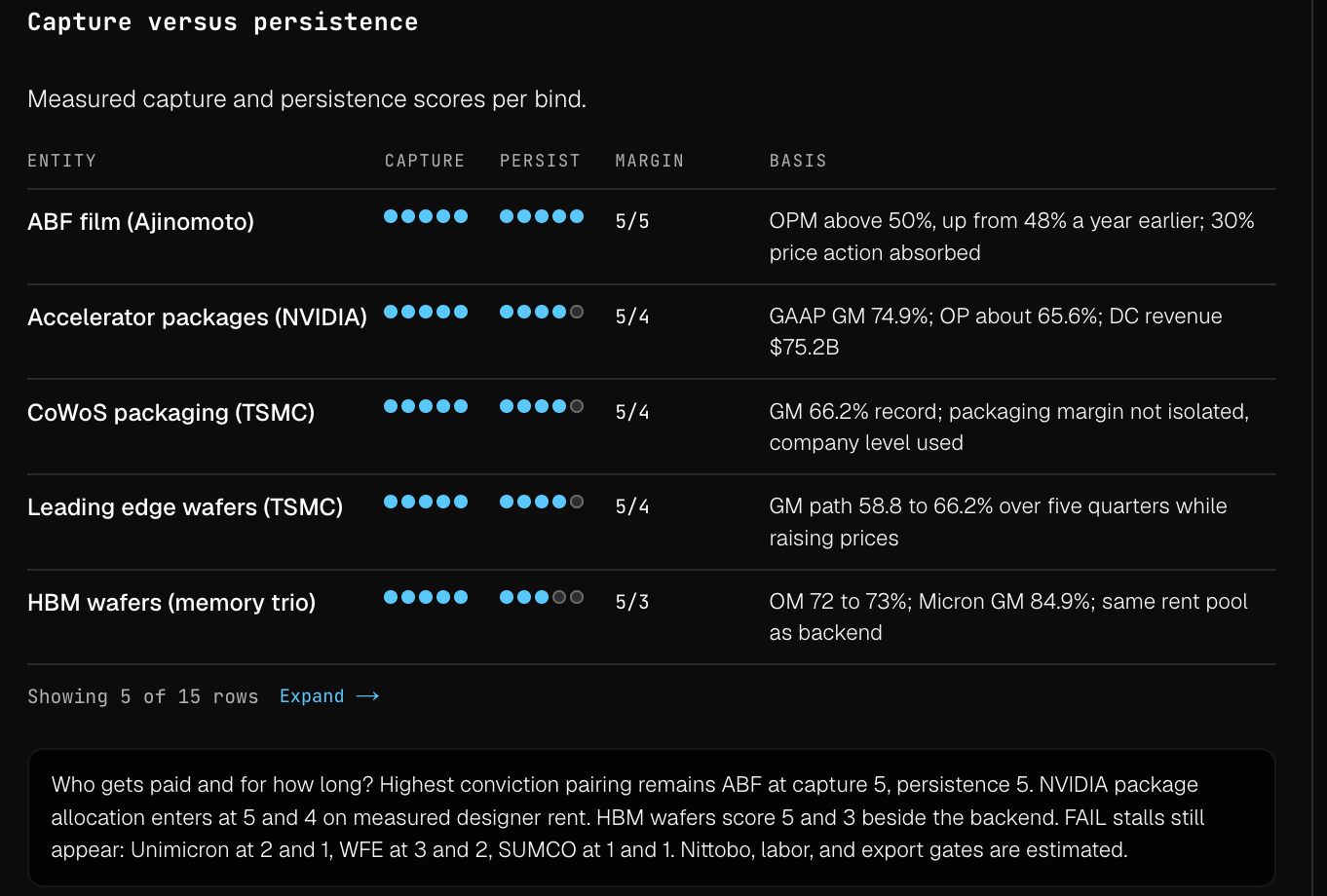
TSMC printed a record 66.2 percent gross margin in Q1 2026, up 7.4 points in a year, while notifying 5 to 10 percent price increases on sold out capacity. Capture stays at the top of our scale even after an Arizona and Intel second source haircut on persistence.
Ajinomoto remains the edition’s highest conviction pairing on materials: electronic materials operating margin above 50 percent, profit up 35 percent to JPY 54.6 billion on about 6 percent of company sales, over 95 percent share, and no competing plant before 2032. Capture 5, persistence 5.
NVIDIA prints designer rent at 74.9 percent GAAP gross margin and about 65.6 percent operating margin, with Data Center revenue $75.2 billion up 92 percent year over year, while holding half or more of 2026 CoWoS on the priority book. That is not a soft allocator story. It is measured margin behind a physical queue.
Memory continues to capture through the HBM and DRAM trio. Micron printed $41.5 billion at an 84.9 percent gross margin on the edition cut. SK hynix and Samsung stay sold out on HBM through 2026 with 2027 already booked. On tools, Applied, Lam, and KLA capture without being co minima on our stall test. That distinction matters. Rent can print at FAIL stall names. Durable scarcity sits at the co minimum.
ASML holds a EUR 38.8 billion backlog with memory EUV sold out for 2026. That supports the wafer and memory ramp underneath the package bind. It does not clear CoWoS, ABF, or T glass by itself.
Where the bind moves next
Hyperscalers are near a $700 billion 2026 spend pace. Memory and packaging for 2027 are already contracted. The forward question is conversion, not marketing.
If CoWoS relief lands toward a roughly 10 percent gap by year end 2026, the physical bind migrates down the substrate chain. ABF gaps widen from about 21 percent toward 42 percent by 2028 on our forecasts. T glass still has nothing before mid 2027. NVIDIA allocation stays the package gate unless non priority books open. In plain English: packaging easing does not mean the AI compute chain is free. It means the scarce layer moves to film, cloth, and allocator priority while HBM stays tight.
Falsifier
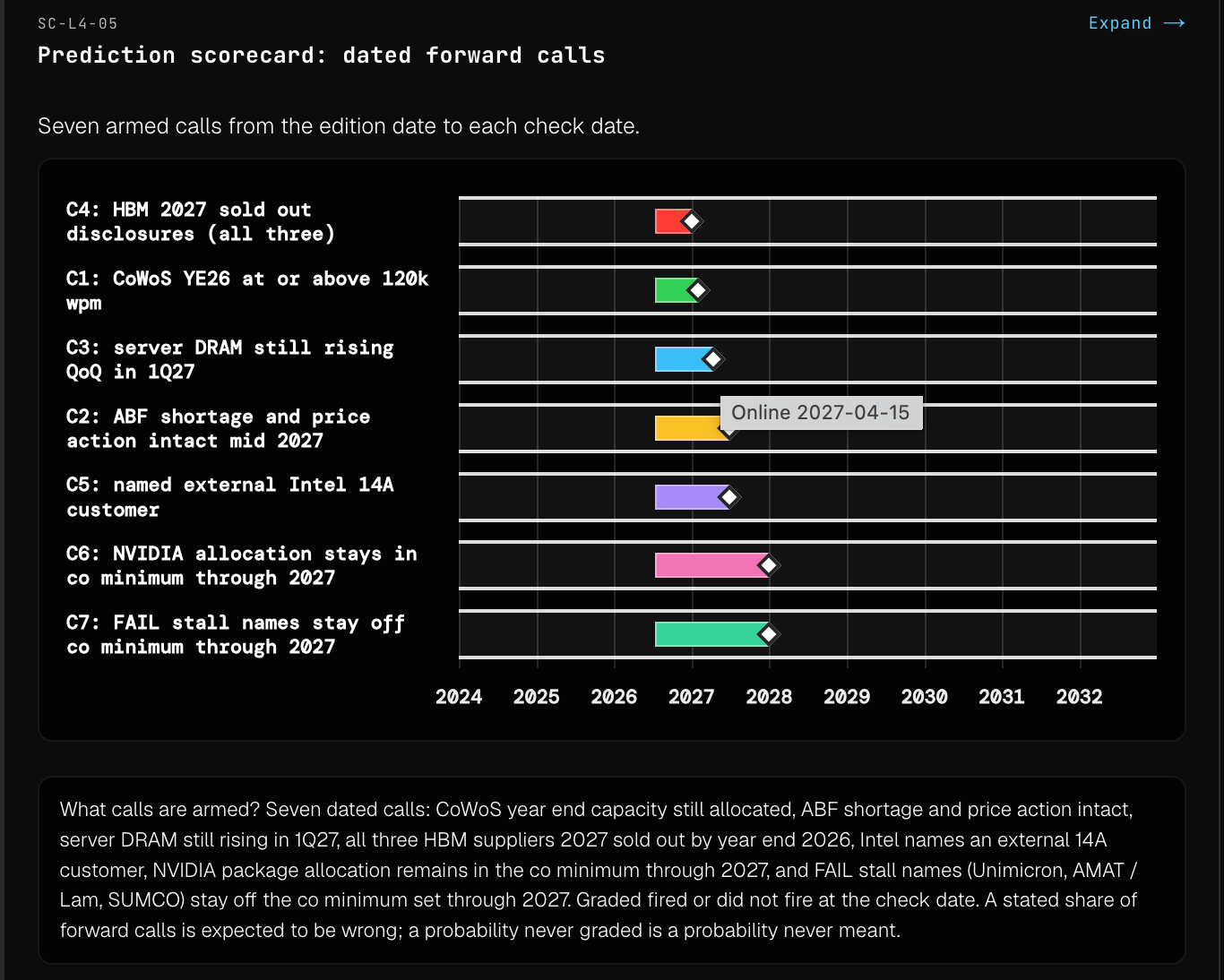
All three HBM suppliers stay sold out for 2027 by year end 2026, and CoWoS year end capacity stays allocated. If either print fails cleanly, the co minimum thesis softens and we say so on the next edition.
Across the book
Data centers
Contracted campus demand remains far ahead of delivered megawatts. Dominion alone holds 51 GW under contract and about 70 GW queued against a 24.7 GW system peak. US colo sits near 29.0 GW. The facility co minimum is still large load interconnection, large power transformers, GSUs, and sole US GOES, with gas slots as the behind the meter escape hatch. NVIDIA Data Center revenue at $75.2 billion a quarter and about 3.2 million Blackwell packages shipped by end 2025 keep the IT fill real. Money sits with Dominion on rate base and take or pay terms, Siemens Grid and Eaton on electrical equipment, Vertiv and thermal peers on cooling, colo REITs on live campuses, NVIDIA on accelerators, and optics names such as Lumentum, Coherent, and Arista on the network path. Commodity steel does not capture the rent. Thesis: holding through 2027 on the facility power path.
Defense manufacturing
Appropriations are real. Delivery is not. Public Law 119 75 put $839.2 billion into FY2026 DoD. Virginia still prints about 1.3 hulls a year against a 2.0 Navy plan. The physical valves remain nuclear yard rates and AMPAC ammonium perchlorate. Money sits with AMPAC, RTX, Lockheed, and General Dynamics on marine and combat. This is the cleanest Independent cash book in the terminal: taxpayer funded demand that still stalls at production rate. Thesis: physical rates, not the appropriation headline, stay the bind into 2027.
Nuclear fission
Demand is real on delivered Vogtle capacity of about 2,234 MW and on funded restarts at Palisades and Crane. Western SMR remains mostly intention after NuScale cancellation. The stall sits at restart COD, domestic fuel cycle capacity, and FOAK execution. Metropolis UF6 conversion, domestic LEU, and Western HALEU still gate commercial megawatts. Money sits with Solstice ConverDyn, Centrus, Urenco, BWXT, OPG with GE Hitachi, and Constellation. Thesis: restart demand holds, fuel cycle co minimum still binds.
Humanoid robotics
Demand is early and mostly intention. Tesla still shows zero Optimus doing useful factory work as of early 2026 and no investable 2026 volume guide against an earlier roughly 10,000 unit path. The co minima are OEM ramp plus useful work, the actuator bill of materials, and the NdFeB magnet stack shared with critical materials. Money sits with Harmonic Drive Systems, Leaderdrive, and Green Harmonic on strain wave reducers, and with Mobis on actuator modules. Thesis: fragile until useful work converts into paid throughput.
Quantum computing
There are enough refrigerators in aggregate. There is not enough commercial conversion. IBM has about 90 deployed systems. Dilution refrigerator capacity midpoints near 265 per year against roadmap incremental demand near 23 per year, so aggregate supply looks loose while quantum grade Bluefors allocation still binds at 6 to 9 month leads and about 84 percent share. IonQ plus Rigetti combined commercial cash sits near $39.5 million in 2026 Q1. Money sits with Bluefors on allocation and with Zurich Instruments, Keysight, and Quantum Machines class control electronics on I/O density. Thesis: allocation scarcity inside aggregate surplus.
Fusion energy
Capital and offtakes are racing first of a kind clocks. CFS has raised more than $3 billion, SPARC construction sits about 75 percent complete, and first plasma still targets 2027. Helion carries a Microsoft 50 MW by 2028 offtake with Washington licenses in hand. Delivered plant megawatts stay unprinted. The stall is fusion grade REBCO at the performance class that matters, magnet fab and test seats, tritium breeding for DT paths, and FOAK licensing plus plant integration. Aggregate HTS tape capacity can look fine while fusion grade allocation still binds. Thesis: fragile. Capital is ahead of printed power.
What would kill the calls this month and into year end
Keep these dated. Soft language is how weekly letters lose trust.
Semiconductors: HBM 2027 sold out prints by year end 2026, and CoWoS year end capacity stays allocated
Critical materials: China separation share stays above 85 percent through 2027, and MP prints Dy and Tb oxide in 2026
Data centers: GE Vernova reaches at least 110 GW under contract by year end 2026, and NVIDIA keeps package allocation inside the IT fill co minimum through 2027
Defense: Virginia does not sustain 2.0 deliveries before 2030, and AMPAC completes 2026 expansion without a second qualified US AP site by end 2028
Nuclear: Crane first commercial generation in calendar 2027, and Centrus commercial HALEU at 12 tonnes per year before end 2029
Humanoid: Tesla discloses sustained useful Optimus factory work at a monthly rate in calendar 2026, or it does not
Quantum: Bluefors quantum grade lead times stay inside 6 to 9 months through end 2027
Fusion: Helion delivers 50 MW of Microsoft offtake power in calendar 2028, and SPARC achieves first plasma in calendar 2027
Open the desk
This letter is judgment on top of a versioned edition. The live Power and Grid IC Summary is public on Atlas Memo. Apply for access if you want every coverage board, every chart with sources, and Atlas AI against the same corpus.
Atlas Memo: https://www.thestratumatlas.com/research is/memo